latest News

Do you have the Barefoot Personality?
Birds of a feather may flock together, but do barefoot runners flock as well... psychologically, at least?Nicholas Hanson and Janet Buckworth think they might, as they describe in the paper they've published in Sport Sciences for Health, "Personality characteristics of barefoot runners: openness and conscientiousness as the defining traits"They put 692 runners through The Big Five Inventory, a psychological typing system. 238 of those runners identified as barefooters who'd done at least a half marathon in the last 2 years.Turns out, they say, that barefoot runners...tend to be more open (imaginative, unconventional, curious) and less conscientious (responsible, dependable, orderly) than shod runners.Think that describes you?You can take the Big Five test and see... there are lots of sites that offer it (click here for search results)(and, no, if you don't fit the mold that DOESN'T mean you can't run barefoot!)
Improve your foot and ankle strength and your balance
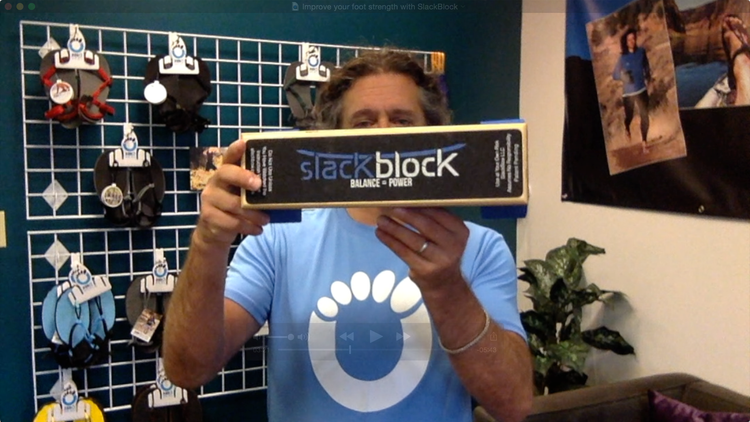
If you want to improve your foot and ankle (and leg and hip!) strength -- and you do -- then you need to see this video.In it, I share something I've never made public before, a very personal story about why strength and balance are so important to us at Xero Shoes. But I also share a new tool you can use to improve your strength and balance in just a few, fun, minutes per day.There are 2 products I'm recommending HIGHLY:One is the AFX Foot Strengthener (a video about AFX is on the way)The other is the Slackblock (that's what this video is about).The content of this post does not constitute and is not intended to be a substitute for professional medical advice, diagnosis or treatment. Always seek the advice of a physician or other qualified health provider with any questions or concerns you may have about your health or a medical condition.

Just say NO to shoes!
And now we bring you a public service announcement from the makers of Xero Shoes:Needless to say, we made Xero Shoes so they don't bind you up and keep you from moving naturally!Think others need to hear this message? Share it (buttons on the left!)

The Shocking Truth about Sprinting Workouts (from Xero Shoes)
Most people associate barefoot running with long distance. But Xero Shoes CEO, Steven Sashen, is a Masters All-American sprinter... the opposite of a marathoner.And while people view the effort, determination, and sometimes near-death experiences of the ultra runner with great respect, sprinting is still the sport that crowns "The Fastest Man in the World."Sure, distance running is hard. But sprinting is WAY hard for a whole different reason, and Sashen explains why here.Whether you run in shoes or bare feet or in sandals, I'm sure you'll never look at a track workout the same after seeing this video.What do you think?Share your comments, below...

Mo The Human's Secrets of Natural Movement and Health
There are two things that I love: Meeting someone new who thinks like I do Learning something new from, well, anyone Well, I got both of my favorite things when I met Mo Goldstein, also known as Mo The Human. And I know you'll enjoy this fun chat, Mo The Human and share a BUNCH of laughs, as well as our thoughts and experiences about: What's wrong with shoes... and what you can do about it What ARE minimalist shoes and should you wear them? Who wins the "sitting vs. standing" contest How to get started with natural movement What to do with kids -- keep 'em barefoot? Put them in shoes? Whether being in bare feet is right for you or not When you SHOULD NOT be barefooted! A LOT more... Enjoy... and tell us what you think in the comments, below.So, what was your favorite part of this video? Tell us, below... and check out Mo's site -- Mo The HumanThe content of this post does not constitute and is not intended to be a substitute for professional medical advice, diagnosis or treatment. Always seek the advice of a physician or other qualified health provider with any questions or concerns you may have about your health or a medical condition.

Is there a Xero Shoes conspiracy?
Some people think that our mission at Xero Shoes is to rid the world of all other sandals, flip flops, and running shoes and replace them with our lightweight performance recreation footwear.Well, Joel Ellis has stumbled onto something about our true plans that's far more sinister, infinitely more insidious, and perhaps even bordering on illegal.Oh, and he also gives a quick review of our new Umara Z-Trail sandal, which you can find here for men, and here for women.Will you fall prey to our nefarious plan to Z-ify your bare feet?OR, worse, have you already become Z-ified? If so, let's see the proof.;-)The content of this post does not constitute and is not intended to be a substitute for professional medical advice, diagnosis or treatment. Always seek the advice of a physician or other qualified health provider with any questions or concerns you may have about your health or a medical condition.

Congrats to the Z-Trail Sweepstakes Winners!
4,117 people entered our Z-Trail our Ultimate Sandal Sweepstakes Giveaway! And we're thrilled to annouce the 61 winners... 58 were randomly chosen and 3 were commenters.And then, well, we added more prizes and winners, as you'll see below ;-)Oh, and over 2,200 people grabbed their Z-Trail sandals during the launch!If you weren't a winner, you can still check out our awesome prize donators. Scroll through the list, and click on the images that you want to check out.[slideshow_deploy id='99247']Our winning commentersFirst, thank ALL of you who submitted comments, especially those of you who've been wearing Xeros and shared your experiences over the years. Please know that we are tremendously grateful for all your support and thrilled to hear about what you've learned, what you've done, and the fun that you've had.Frankly, there were WAY more than 3 that we loved so, picking "winners" was a real challenge. Search for the winners in the comments below; you won't be disappointed.Our top 3 commenters, who each get a pair of Z-Trails:First, for both volume and creativity, Erik Thompson. Erik submitted a LOT of comments, each one more fun than the next (and you know we like to #FeelRealFun around here). One sample: I want some Umara's to traverse the Sahara, and feel the sun on my rubber-soled toes, Not booties nor Vibrams or five-fingered slip-ons shall grace my ground hands as friendlies or foes. Next, I have a phrase that I use a lot when I'm evaluating anything: "Let's look at the math." And, yes, I say that about things that have nothing to do with math. But Robby Clark got me with his Xero sum math: 1) The idea of absolute truth has interested philosophers, scientists, and ... 2) In science, doubt has been cast on the notion of absolutes by theories ... 3) In pure mathematics , however, there is said to be a proof for the existence of absolute truth. mathematically --- where p=price, f=fun, r=run, c=climb, c1=comfort, h1= health and wellness, Z= Z Trail Sandal f + r(c)/ p(c1) (h1 )= Z Finally (kinda... you'll see in a moment), Lena is an award-winning novelist, so we were taken by one of the longer entries, practically a short story by Rachel: There was once a woman who wished to liberate her feet from stiff leather and heavy soles, so she removed her shoes and went barefoot. The first few steps were bliss, but as she continued along a sun-heated path strewn with sharp-edged stones, her pleasure turned to pain. With a heavy heart, she put her shoes back on again, still yearning for freedom. In desperation, she set out to consult the sage who lived high on a mountain. Though her legs grew heavier with every step, she at last reached the summit, and found the sage seated in front of a cave. Before the woman could even catch her breath, the sage looked at the confining shoes on her feet and nodded. “Umara Z-Trail”, he pronounced wisely. “The ultimate sport sandal.” “Pardon?” said the woman, still wheezing. “thexeroshoessale.com,” said the sage. He reached into the cave and drew out a pair of the lightest, most streamlined sandals the woman had ever seen. To her wonder they fit like a second pair of skin. She could feel the earth under her soles; she could splay her toes, point and flex and arch her feet. Best of all, there was no discomfort as she walked and then leaped around the rocky summit. “Thank you, oh thank you!” the woman exclaimed. “De nada,” said the sage. With the surefootedness of a mountain goat, and the spring of a gazelle, the woman descended the mountain. And she walked, skipped, and ran happily ever after. But there was an audience favorite (that we also liked)... so we added one more winning pair to:William Kennedy, whose post had the most Likes:I'd like to win the Z-Trail, I'd like to win them now, I'd like to win the Z-Trail but I do not quite know how. You see, my writing's not that funny, My writing's not that grand, My writing's not that catchy, In fact, it's rather bland. Oh wait, I'll write a poem, Or maybe it's a song, Regardless of it's structure, I hope you'll follow along. I'll wear them in the daytime, I'll wear them late at night, I'll wear them while I lay in bed, (Just do not tell my wife). These Z-Trails look amazing, These Z-Trails look so sweet. Thank you Steven and Lena, for caring for our feet.Then we decided that some of our other favorites deserved Honorable Mentions... and $25 gift certificates.Thanks Dominique Navarro, who also rhymed her way into our hearts:There was an old lady who lived in her shoes, She had such sore feet she did not know what to do! She sought out help from her doctor, chiropractor, and more, and to her dismay she got sent to the store, To purchase orthotics, support shoes, and drugs For the pain that just got worse from the advice of those thugs. She cried in agony desperate for help, when miraculously she found a video with Master Sashen! He shared with the world his wisdom about shoes, And said, keep wearing em and guaranteed you'll lose. So she decided to go xero for the sake of her feet, And shared xero wisdom with all she would meet. Buy xero shoes and feel the world if you dare, Z-trail are the newest so go get a pair! ?Another volume contributor, Ian Salsman never failed to entertain. His simplest says it best:Xero Shoes rock so I don't hurt my feet when I step on those rocks.but he also went for the sing-along riff with:I'm so excited And I just can't hide it I'm about to lose control and I think I like it I'm so excited And I just can't hide it And I know I know I know I know I know I want [Z-Trail] I want [Z-Trail]And, finally, Sara T simply nailed it with her review:I've been salivating over the new Z-Trail design for days. While I love the design of Chacos, and have bought 3 different pairs over the years, they have all been relegated to eBay, as I despise 1) the ridiculous weight and 2) the molded arch. My poor flat feet hated them with a passion, but they were the outdoor sandal I was "supposed to" wear. So while hemming and hawing about whether to buy a pair, I remembered my DIY kit sandals I bought back in '12 and wore faithfully for several years. I couldn't justify purchasing more sandals when I still have plenty of my 5,000 miles left on these, and hadn't even been faithful to the barefoot cause (I'm so ashamed!). So I took them for a spin this morning, instead of the Brooks I've been hiking and jogging in. AMAZING! While I've been lazy about which shoe to wear, I've (naively) tried to keep my barefoot mechanics. And this morning, in my trusty huaraches, I realized I had completely failed! Typical running shoes are impossible to run properly in. This morning, it all came back. My toes pointed, my feet landed under my body, my heels kicked up more, my toes and arches were engaged, and I immediately started stepping over the log again (best visualization I had learned for how to step). I was jogging for real, not plodding along. Thank you, Steve and Lena, for continuing to realize the vision, for all the hard work you put into a product you believe in, and for the excellence you put into your products and customer service.Dennis (our product designer) and Janice (our Customer Happiness Manager) were in the military, so they especially liked Sonia's "FOX's Creed":These are my Z-Trail Sport Sandals. There are many like them, but these are mine. My Z-Trail Sport Sandals are my best friend. They are my life. I must master them as I must master my life.And now onto our random winners: The ULTIMATE Sandal Giveaway

Football leads to concussions. Does running lead to "foot concussions"?
Can you guess what these two athletes have in common? On your left, John Krahn. Seven feet tall, 440 pounds. On your right, Jessica Trengove, 5'5", 115 pounds.Have you guessed yet?The answer is as far on opposite ends of the athletes themselves as the athletes are far from each other in stature.Here's a hint: Krahn's head... and Trengove's feet.The answer: FORCE.Football players send a LOT of force through their helmets and into their heads, leading to concussions. Check out the Will Smith movie, Concussion, for a revealing look into this phenomenon.Runners send a lot of force through their shoes, into their feet, ankles, knees, hips and back, leading to all manner of joint injuries. I think we should start calling these "foot concussions."The "solutions" offered to both athletes has been the same for decades: more and more padding, shock absorbing technology, high-tech materials to handle the high-impact forces.And I put the word solutions in quotes because none of these interventions have eliminated, or even reduced, the problem.But barefoot runners have been offering a solution is for both athletes:To reduce injury, runners should take off their shoes. Football players should take off their helmets!Harvard's Daniel Lieberman showed how removing your shoes can lead to running form changes that reduce force through your joints. How does this happen? Because the form you adopt when running in padded footwear, ironically, puts MORE force through your joints. When you try to run barefoot with a "shoe wearing gait," it HURTS... and so, to avoid the pain, you'll learn to run with a gait that, instead of relying on footwear padding, uses the natural shock absorbers built into your body -- your muscles, ligaments, and tendons.(BTW, most "minimalist" shoes have enough padding that you don't get the form-change inspiring feedback. That's why Xero Shoes use our FeelTrue® rubber to give you just-right protection.)Well, this just in from the "No surprise" category: "Helmetless-tackling training intervention reduced head impacts in collegiate football players within 1 season."I know you'll find this screamingly obvious, but when football players take off their helmets so they can no longer use their heads as the front end of a battering ram, they naturally stop this concussion-causing behavior.Duh!So the REAL solution seems obvious. Why aren't people rioting in the street for the eradication of helmets and 2" thick padded running shoes?I think there are two reasons, inertia and vested interests.By "inertia" I mean that we've now had more than 2 generations of "we need better helmets/shoes." That's enough time to inculcate the idea that "more = better." It takes time and effort to get people to stop believing "common wisdom" and change directions. It's not easy to make a big boat do a U-turn. It took almost a generation to reduce the incidence of smoking after it was proven that smoking is bad for you.Vested interests? Well this one's easy. Big companies are making billions of dollars on head-smashing football games and on foot coddling running shoes. Billion dollar companies would rather argue that they're correct -- in the face of glaring evidence to the contrary -- than say, "Wow, we've had our heads totally up our butts for the last 40 years and caused you all a TON of injuries. Sorry 'bout that!"This is why any seeming "pro-barefoot" news is immediately jumped on by shoe companies, and why any news that could possibly be spun into "anti-barefoot" is, well, spun like a top, regardless of the facts. For example, shoe companies jumped on the class action lawsuit against Vibram as "proof" that barefoot is bad for you, when neither the suit itself or the fact that the lawsuit settled for essentially pennies, suggested anything of the sort.What to do?I wish I had a great answer, since getting people into footwear that supports natural movement and ground feel is our company's and my personal mission.I guess I'll start by attending football games the same way I attend every day of my life: barefoot or in Xero ShoesThe content of this post does not constitute and is not intended to be a substitute for professional medical advice, diagnosis or treatment. Always seek the advice of a physician or other qualified health provider with any questions or concerns you may have about your health or a medical condition.

Proper Barefoot Running Form... NOT!
If anyone asks you what proper barefoot running form looks like, you can show them this video clip...... and say, "NOT THIS!";-)

Treadmill running without a treadmill
What if you want to run on a treadmill... but can't afford a treadmill?Maybe this is your answer.Give it a try? ;-)

Lose Shoes Now. Ask Me How.
Tired of people asking the same 'ole questions as you walk or run barefoot (or in Xero Shoes)?Well, how 'bout some shirts that do the speaking for you?I've got a series of them planned out... here's the first two (one "generic" and one Xero). Click on the image to order... Oh, and you can change the shirt style and color if you like! How is "Lose Shoes Now. Ask Me How." the answer? It's not. But our new slogan (and hashtag) #Feel.Real.Fun. sure is.Your feet are supposed to FEEL.Being bare is REAL.And, most importantly, it's FUN!In fact, if you're not having fun, you're not doing it right. :-)

The Barefoot Running world has lost a true friend
There are a number of semi-celebrities in the barefoot running world (that is, famous in the niche, but not necessarily well known to the general public).But there's one man whose influence and value to those of us who support and benefit from natural movement eclipses all the celebs combined.His name is Bill Katovsky and this post is an all-too-brief and undeniably insufficient memoriam, as Bill unexpectedly died last week.Only those truly "in-the-know" and attentive to the goings on in the barefoot and minimalist movement (and the seeming backlash from maximalist footwear), have a glimmer into how much Bill contributed, since Bill was in the background more often than the foreground. And if I list his credits, I'll surely underestimate Bill's level of responsibility. From co-authoring books, like Tread Lightly, to writing innumerable articles, to co-creating and managing the idea of Natural Running Center-affiliated stores, to maintaining the online presence for NRC... many of you reading this now are here, in part, thanks to Bill's efforts.Personally, my relationship with Bill was one that could only have existed in the Internet-age. He found me online, and then called for a "brief chat" that lasted 6 hours.We never met in person, though I regularly offered to fly him to Colorado so we could plan our barefoot takeover of the world.We spoke almost weekly, usually for hours at at time. On average, Bill and I exchanged at least one email per day. And I say "on average" because I might not hear from Bill for a few days, but when he was on a creative rant, I'd get 10 or 20 within minutes of each other.Putting into practice the myriad marketing ideas that Bill tossed in my direction would take more than a lifetime for more than one company.Bill had an encyclopedic memory of all-things running and triathlon (he coined the term triathlete, and founded the magazine of that name). And we shared a deep passion for finding the underlying truth about human performance, and all forms of comedy (hence our 2 hour "chats").Bill was always a huge supporter of me and of Xero Shoes, both as a product and a business. He was the ultimate sounding board. Generous with his mind and ideas. And his death is truly a loss for the barefoot and natural movement community.We can only hope to honor his memory by bringing to fruition all that he wanted for us and the world.You can find more about Bill from some who were closer to him than I:From Nick Pang - http://naturalrunningcenter.com/2015/11/09/bill-katovsky-1957-2015/From Roy Wallack - http://www.slowtwitch.com/Opinion/Bill_Katovsky_R.I.P._5456.htmlFrom Scott Tinley - http://www.trihistory.com/t-3/death-voice#/0